Nicky Nook Magical Mystery Tour
“How did Nicky Nook fell get it’s name” is one of the mysteries of Lancashire. This pretty fell above the beautiful village of Scorton, looks out from the western edge of the Forest of Bowland. A popular local walk, with a brisk uphill, rewards the Sunday hiker with one of the finest views of Bowland and Morecambe Bay.
When I started Bowland & Bay, artisan food tours back in 2020, this was my place to think. With inspirational views across the bay to Barrow and the Lake District fells and south to the Lancashire plains. Sunrise or sunset, full moon or northern lights, this fell is a magical place, filled with tales to be told.
For the last year I have been working on my new book “Fieldnotes for Foodies”, gathering stories of food & drink from our independent producers, farmers and makers. Along the journey bread crumbs started to appear, returning me to Nicky Nook and back through a thousand years of folklore. Over the last six months, I have spoken at farmers dinners and to local historians, along with my lovely food tour guests, about my Nicky Nook theory. Now for Lancashire Day 27th November, I am sharing to see if my theory holds water, which would be very apt indeed.
Fjall to Frozen Horses
The answer to our mystery lies in language. A thousand years ago Vikings settlers lived amongst the hills of the north of England. Their legacy can be found in the root of the word fell for a hill (in old norse a fjall). Nicky Nook lies just south of the old viking homestead of Dolphinholme. An ideal lookout post to see the land around and more importantly the water.
If you know anything about Lancashire, you know we are in good shape for water. From Nicky Nook fell you can see the rivers Lune & Wyre, the enormous tidal shift of sea across the bay, the weather systems
 and more importantly where the land floods. Fear of water would be important to survival and farming. Across Northern Europe every culture had a name for water demons who might lure you to your death, through ponds, rivers and bog land. It is in these names that we may find our answer.
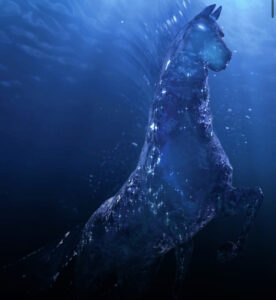
In Germany these water demons would be called a Nixe, in Swedish a Nack, in Old Icelandic a Nykr and in old norse a Nykk or a Nokk. This is where I believe our Nicky Nook fell’s name springs from. These demons could be male, female or even a horse (the Kelpie legends of the borders of Scotland and the Nokk of Disney movie Frozen II).
Gindlylows to Greenteeth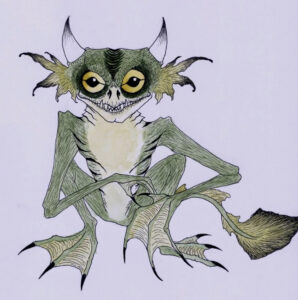
In old English these water demons were called Nicors and can be found in the stories of Beowulf, in the giant Grendel’s mere, attempting to drown the hero. These supernatural creatures, that dwelt among the bogs, ponds and marshes. Shaped like dimunitive humanoids, with a greenish complexion, scaly skin, sharp claws & teeth. With their spindly arms and long fingers they would grab and entwin unsuspecting folks to a watery end. From Grendel’s moat, their name transformed to Grindlylows and if you think that sounds familiar, they are the same little monsters that try to drown Harry Potter in Hogwarts lake.
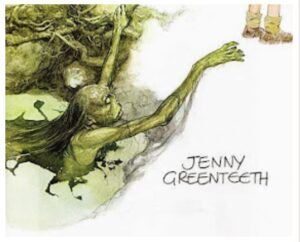
In Lancashire we love a watery demon and even more so a watery witch. So for those with longer memories the legend of Jenny Greenteeth remains a potent warning to small children to stay clear of dangerous water. This Lancashire watery hag, would lure the unsuspected into green ponds and canals. Just as Grindlylows (Greenteeth) and Nykk Nokk before them.
Hidden in plain sight, almost lost, tantalising close, this is my theory for how Nicky Nook got its name. It’s a lighthouse look out point for the perils of water demons. A vantage point for the changing seasons, tides and weather. So next time you head up to Nicky Nook, imagine a viking stood by your side scanning the horizon and beware Jenny Greenteeth on the ponds on the way down.
If you would like to find out more folklore & legends, drop me a line, hello@bowlandandbay.co.uk for more information of artisan foodie adventures, across the auld Lancashire palatine.